Who’s afraid of the “kill switch”?
By Carlos Blasi - CTO My Media Connect
What the case in The Hague reveals about digital sovereignty and packaging management.
In August 2025, the United States added Canadian judge Kimberly Prost and French judge Nicolas Guillou, both of the International Criminal Court (ICC), to a sanctions list. Months later, the consequences were no longer a legal abstraction: Prost described restrictions on using bank cards, signing up for services and carrying out everyday transactions, even outside the United States.[1]
What is unsettling about the case is not only its political dimension. It shows how far our activities depend on digital services, payment networks and suppliers subject to regulatory decisions taken in other countries. A server doesn’t have to fail for you to lose access to a system. Sometimes an administrative decision is enough.
In October 2026, Washington extended the sanctions to the ICC itself as an institution. At the same time, the US authorities issued general licences permitting certain transactions, including some linked to telecommunications and business software. The takeaway is not that all technology suddenly switches off, but that access can become uncertain and depend on rules the end user doesn’t control.[2]
What is a digital “kill switch”?
In this context, “kill switch” does not necessarily mean a physical button or a technical feature built into software. It is a way of describing the risk that access to critical technology is interrupted or restricted by external decisions: sanctions, export controls, contractual changes or restrictions imposed by a supplier.
Sanctions administered by OFAC, the US Treasury office responsible for foreign assets control, can restrict certain transactions with designated persons or entities. Their actual effect depends on the specific rule, the parties affected and the licences or exemptions that apply.[3]
The ICC episode is not the only one that calls for a review of dependencies. In June 2026, the United States restricted foreign access to two advanced Anthropic AI models; the company temporarily disabled those models and the restrictions were lifted the same month. It was an interruption limited in time and in the products affected, but it revealed the role jurisdiction plays in technological continuity.[4]
Why are European companies worried about digital sovereignty?
The concern has already reached the boardroom. In a Proton survey from July 2026 of 1,500 business leaders in the United Kingdom, Germany and France, 74% said they were worried that a US provider could interrupt a critical service as a result of a government decision. This is a perception of risk, not a prediction of mass outages.[5]
The German association Bitkom offers another signal: in a survey published in October 2026, 96% of participating companies said they buy digital technologies or services from abroad; faced with a total halt to those imports, they estimated they could hold out for 16 months on average. That doesn’t mean 96% will go bust within two years, but that technology dependencies are part of operational risk.[6]
The question for any organisation is therefore a very practical one: if one of our critical suppliers stopped operating tomorrow, which processes would grind to a halt, and how would we recover them?
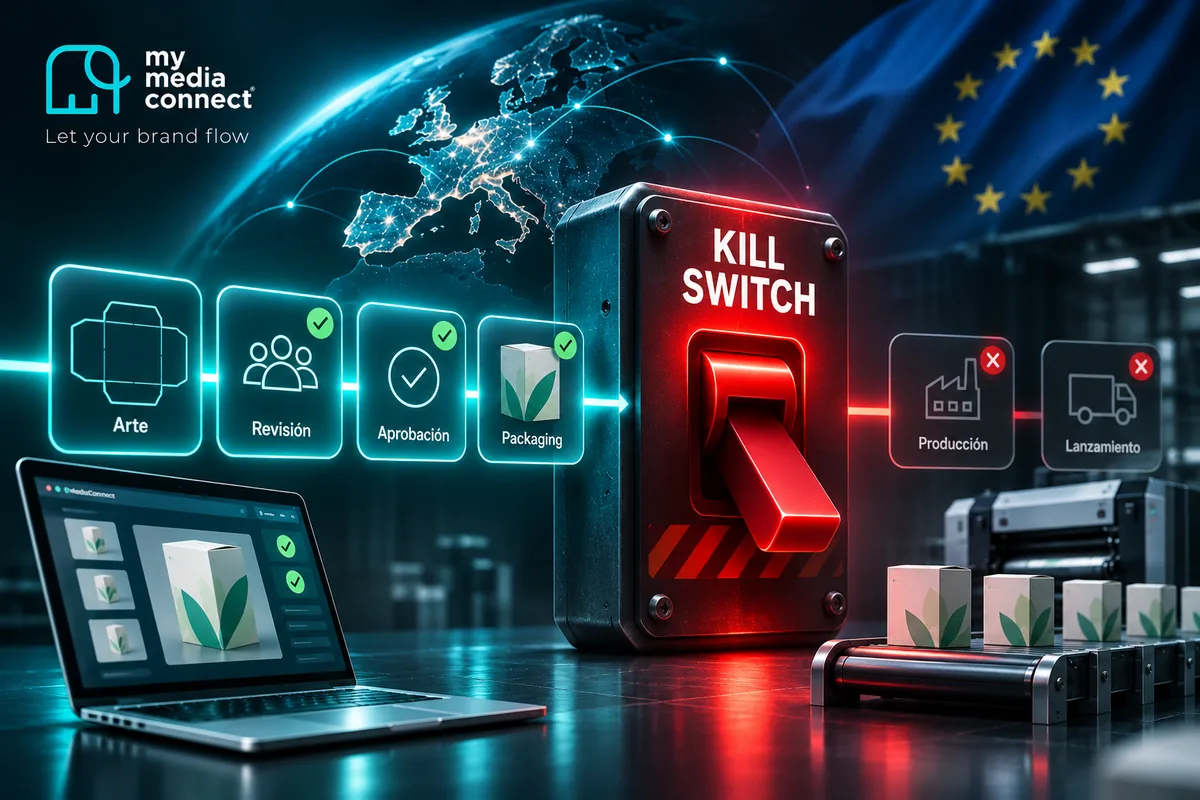
So what does a “kill switch” have to do with your packaging?
Far more than it seems. A packaging management or artwork management platform holds the final artwork for every SKU, EAN codes, legal and regulatory information, marketing comments, quality reviews and the approval history. It is the documentation that gets a product onto the shelf in the right pack.
When a brand can’t review, approve or deliver its final artwork to the printer, the problem is no longer just an IT issue. It can mean delayed launches, last-minute changes, extra production costs or difficulty proving which version was approved and by whom.
Picture a brand with dozens of markets, several agencies, manufacturers and hundreds of SKUs. What would happen if access to its approval system were cut off just before an international campaign? The question is not only where a file is hosted, but who controls access, how traceability is preserved and how long the company would take to resume its workflow.
The EU Packaging and Packaging Waste Regulation —PPWR, Regulation (EU) 2025/40— became generally applicable on 12 August 2026, although various provisions follow their own timelines. Its requirements reinforce the need to keep packaging information accurate, versions under control and review processes well documented. Software doesn’t replace regulatory compliance; it helps organise the work that makes it possible.[7]
Our approach: European technology for critical processes
At MyMediaConnect we have chosen to develop the platform in Europe and host our customers’ data on OVHcloud’s European infrastructure, in line with the company’s operating architecture. This decision reflects one priority: making it easier to keep brand assets under control and reducing certain external dependencies in a particularly sensitive workflow.
That doesn’t make any platform immune to incidents, extraterritorial laws or supplier failures. Nor is saying “European hosting” enough to demonstrate digital sovereignty: ancillary services, access permissions, recovery and data portability must be assessed as well.
“At MyMediaConnect we are committed to a European architecture and to keeping brand assets and approval processes under control. Digital sovereignty doesn’t mean promising zero risk: it means reducing dependencies, improving traceability and preparing for operational continuity so that an unexpected technology issue doesn’t bring a launch to a standstill.”
Carlos Blasi, CTO of MyMediaConnect
The European Union is also stepping up this debate. In June 2026, the Commission proposed the Cloud and AI Development Act, still going through the legislative process, to boost European capabilities in cloud and artificial intelligence. The answer is not to give up on global technology, but to choose the dependencies of each critical process deliberately.[8]
Who’s afraid of the “kill switch”?
Perhaps the best answer is not to be afraid. It is to know what could fail, which part of the business would be affected and how to keep operating. In the graphic supply chain, digital sovereignty is not a political slogan: it is one more dimension of risk management, alongside quality, traceability and launch deadlines.
Because when a packaging workflow stops, it isn’t just a file that gets blocked: a brand can come to a halt.
Frequently asked questions about digital sovereignty and packaging management
Is a platform hosted in Europe protected against any “kill switch”?
No. European hosting can reduce certain dependency and data transfer risks, but you also need to review the provider, its subsidiaries, sub-processors, integrations and continuity plan. Server location alone does not guarantee absolute protection.
Why is the artwork approval workflow critical?
Because it brings together the final packaging versions, sign-off from marketing, quality and regulatory, and the traceability of approvals. If it is interrupted, a company may have to delay pack changes and launches.
What should a brand ask its packaging software provider for?
Information on hosting and sub-processors, access controls, backups, recovery, data export, audit logs and service level agreements. Ask for evidence rather than settling for sales claims.
Sources
- Associated Press / Courthouse News — consequences of the sanctions on judges
- ICC (09/10/2026) — sanctions against the institution
- OFAC — sanctions programme and general licences (including General License 14)
- CSIS (16/06/2026) — restrictions on certain Anthropic models
- Proton (06/08/2026) — survey of 1,500 business leaders
- Bitkom (19/10/2026) — digital dependency of German companies
- European Commission — Regulation (EU) 2025/40 (PPWR)
- European Commission — Cloud and AI Development Act proposal (03/06/2026)